Signed in as:
filler@godaddy.com

Ng Ga Kuen, also known as 5-Family System, is a Southern Chinese Kung Fu martial arts system. This system integrated various selective and targeted techniques from five Southern Shaolin 南少林 descendants to form Ng Ga Kuen (五家拳), focusing on balance, position, effective posture transition, speed, directness, and strength for combat purposes due to civil unrest at that time in history. Ng Ga Kuen (5-Family System) Ng Ga Kuen, the 5-Family System, is a powerful Southern Chinese Kung Fu lineage born from the wisdom of five legendary Shaolin families. This dynamic system blends the best techniques from each family to create a practical, combat-ready art that trains both body and mind. Key martial art strategy highlights: - Balance and Stability: Master stance and weight distribution to stay grounded and ready for anything. - Precise Positioning: Learn how to hold the right angles, create space, and control the battlefield. - Fluid Posture Transitions: Move with purpose—switching from defense to offense in a single, seamless flow. - Speed and Directness: Hit hard, fast, and straight to the target with clean, efficient movements. - Strength with Purpose: Build practical, real-world power through alignment, structure, and breath control. - Combat Mindset: Develop timing, anticipation, and strategic thinking to outmaneuver opponents. - Realistic Scenarios: Train with controlled drills that simulate street-smart self-defense while prioritizing safety and respect. Why Ng Ga Kuen stands out: - A rich Southern Shaolin heritage blended into one cohesive system. - Techniques selected for effectiveness in real-life situations, emphasizing quick, decisive responses. - A holistic approach that builds confidence, discipline, and resilience in every student. What students learn: - Foundational stances, balance, and footwork - Targeted strikes, blocks, and safe, powerful combinations - Strategic transitions between offense and defense - Simple, practical self-defense concepts suitable for real-life scenarios - Focus, discipline, and respect that translate beyond the mat
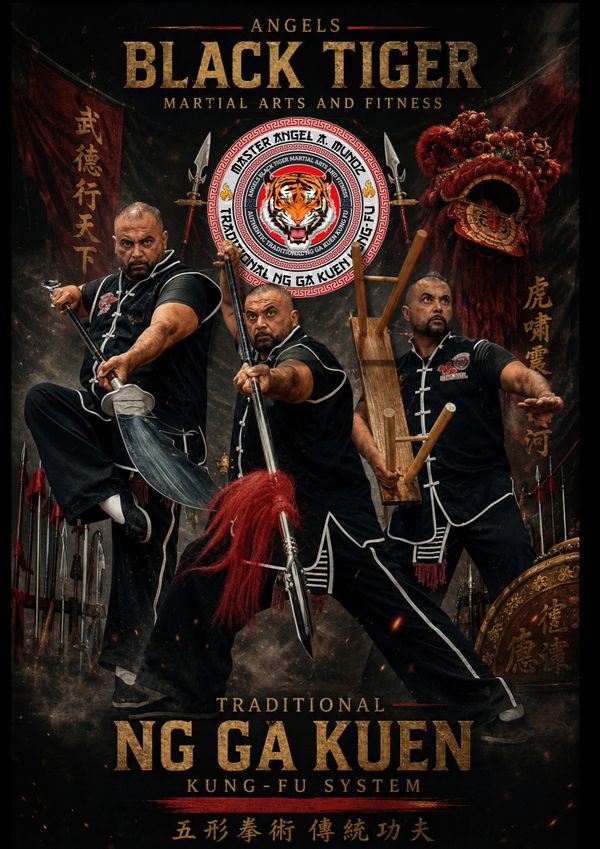
*The Power of Five in Ng Ga Kuen Kung Fu* Ng Ga Kuen Kung Fu is defined by its practical approach, focusing on three key areas: *1. Power/Strength (五家五劲 [jing]):* - Hard: Block and punch. - Soft: Circular moves. - Abstract: Stance transitions. - Solid: Punching. - Cross: Palm hits. *2. Combat Concepts (五家五战):* - Striking: Direct attacks. - Blocking: Defense. - Locking: Immobilization. - Sweeping: Balance disruption. - Redirecting: Using opponent's force. *3. Breathing Rhythms (五家运气手法):* - Abdominal Breathing - Attention Breathing - Reverse Abdominal Breathing - Upper Chest Nose Panting - The Completed Breath These elements foster strength, technique, and mindfulness in martial arts practice. Ng Ga Kuen Kung Fu embodies a practical, battle-tested approach. It channels strength, strategy, and mindfulness into three core pillars that guide every drill, form, and sparring exercise. 1) Power and Structure (五家五劲 [jing]) - Purpose: Build versatile power for real-world impact. - Components: - Hard: Direct blocks and clean, powerful punches. - Soft: Circular, flowing movements to control distance and timing. - Abstract: Purposeful stance transitions that keep balance under pressure. - Solid: Reforged, precise punching mechanics—hips, shoulders, and fist alignment. - Cross: Strategic palm strikes that disrupt an opponent’s rhythm. - Fighting Strategy: - Establish a solid base to withstand counters. - Create short, explosive bursts to surprise and overwhelm. - Use flowing adjustments to redirect momentum and open a path for the next move. 2) Combat Concepts (五家五战) - Purpose: Translate technique into effective, game-ready responses. - Components: - Striking: Direct, decisive attacks aimed at vulnerable zones with proper form. - Blocking: Active defense that sets up counterattacks. - Locking: Safe immobilization to break an opponent’s balance (when appropriate and controlled). - Sweeping: Disrupting balance to topple or unbalance an opponent. - Redirecting: Redirection of force—steering the opponent’s energy to your advantage. - Fighting Strategy: - Read the distance and tempo; respond with the simplest, most effective option. - Transition smoothly from defense to offense in a single focused motion. - Use angles and movement to keep the opponent on the back foot. 3) Breathing Rhythms (五家运气手法) - Purpose: Link breath to power, speed, and calm under pressure. - Components: - Abdominal Breathing: Build core stability and endurance. - Attention Breathing: Maintain focus during exchanges. - Reverse Abdominal Breathing: Recycle breath for quick recovery between moves. - Upper Chest/Nose Panting: Short, sharp breaths to sustain rapid actions. - The Completed Breath: Integrate breath with timing for powerful, controlled techniques. - Fighting Strategy: - Breathe to lock in power and precision. - Use breathing to stay calm, read the opponent, and optimize recovery. - Synchronize breath with moves to maximize impact and control. Why this matters for students and real-life self-defense - Builds confidence through repeatable, practical responses to common scenarios. - Emphasizes balance, timing, and disciplined power over brute force. - Fosters focus, respect, and responsibility—core values inside and outside the dojo.